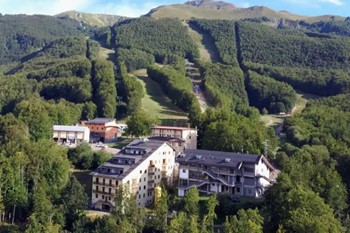

Abetone: Loc. Abetone (Pistoia)
Abetone (mt 1388 asl) derives its name from a huge fir, so great that it can not even be embraced by six people with outstretched arms, which was demolished to make way for the eighteenth road Modenese. Before then, the town was known as Boscolungo name today identifies a fraction of the municipal district (mt 1378 asl). If the history of the first inhabited dell'Abetone is closely linked to each other via the Modenese, the Apennine ridges around since ancient times were affected by major roads link. They are in fact known at least since Roman itineraries transappenninici that traverse mountains of Pistoia, connecting the north and south of the peninsula: it seems that Hannibal has used these ways to get in Etruria. Although we do not know the exact pass chosen by the Carthaginian leader, a tradition identify with the local high Val di Luce (mt 1512 asl), northwest dell'Abetone, where it is located, m. 1798 quota, so-called Step of Hannibal. Despite the Apennine passes are popular only in 1732 he set to hand a first draft for a road through the high peaks, congiungesse Pistoia with the Emilia Romagna. The new road, wanted dl Grand Gian Gastone of Doctors, however, was made by road only Pistoia to Capostrada. Land border between the Grand Duchy of Tuscany, the Duchy of Modena and the Republic of Lucca, the forest became dell'Abetone preferred destination for fugitives of every kind, and among the woods dell'Appennino shelters were comfortable and easy escape routes. With the opening of the street Modenese, not only factories and inns were built, but entire families of farmers, who were granted land to build their homes, moved in the mountains to provide for the maintenance of the road, giving life to the settlements that today is the City of Abetone. The Unification of Italy scored a critical moment for the Abetone, when the disappearance of borders led abolition of customs and then traffic connected to them. Starting in 1863, the opening date of Porrettana Rail, road Modenese lost the function of main link between Tuscany and Emilia Romagna. The years of the early twentieth century and were certainly crisis, and the economy remained essentially local linked to the work of forests and the production of coal. The first skier was introduced in the country in 1904, but tourism began to speak when the Abetone was "discovered" by some families of Italian nobility: between those who stayed remembers Giacomo Puccini, who owned a villa. The first real boost tourism the Abetone experienced in the Thirties, when the engineer Lapo Farinati Uberti promoted the development of the Valley Pozze (now Valley of Light), with projects aimed at the realization of a major ski resort, with hotels , slopes and lifts. The Second World War interrupted definitely work in the Valley of Pozze and for the effective exploitation of the area have had to wait more recent years when, thanks to the fame of the great champions of ski Zeno Colò, Cellina Seghi and Vittorio Chierron, Abetone it has turned into one of the most famous ski resorts in Italy. For major sports are dedicated five of the forty slopes down the slopes of Le Queens, Sestaione (mt 1309 asl), Pass Selletta (mt 1711 asl), Pass the Fariola (mt 1753 asl), Pass Hannibal (mt 1735 asl), Mount Bend (mt 1892 above sea level) and Faidello (mt 1288 asl). Two tracks are dedicated to cyclist Fausto Coppi, in 1940, still unknown gregarious, won the Tour of Italy twenty at the height dell'Abetone Pass. The Abetone is common autonomous from 1936. Venue Town: Abetone (mt 1388 asl) Fractions: Boscolungo (mt 1378 asl), Le Regine (mt 1258 asl), Val di Luce (mt 1512 asl)